

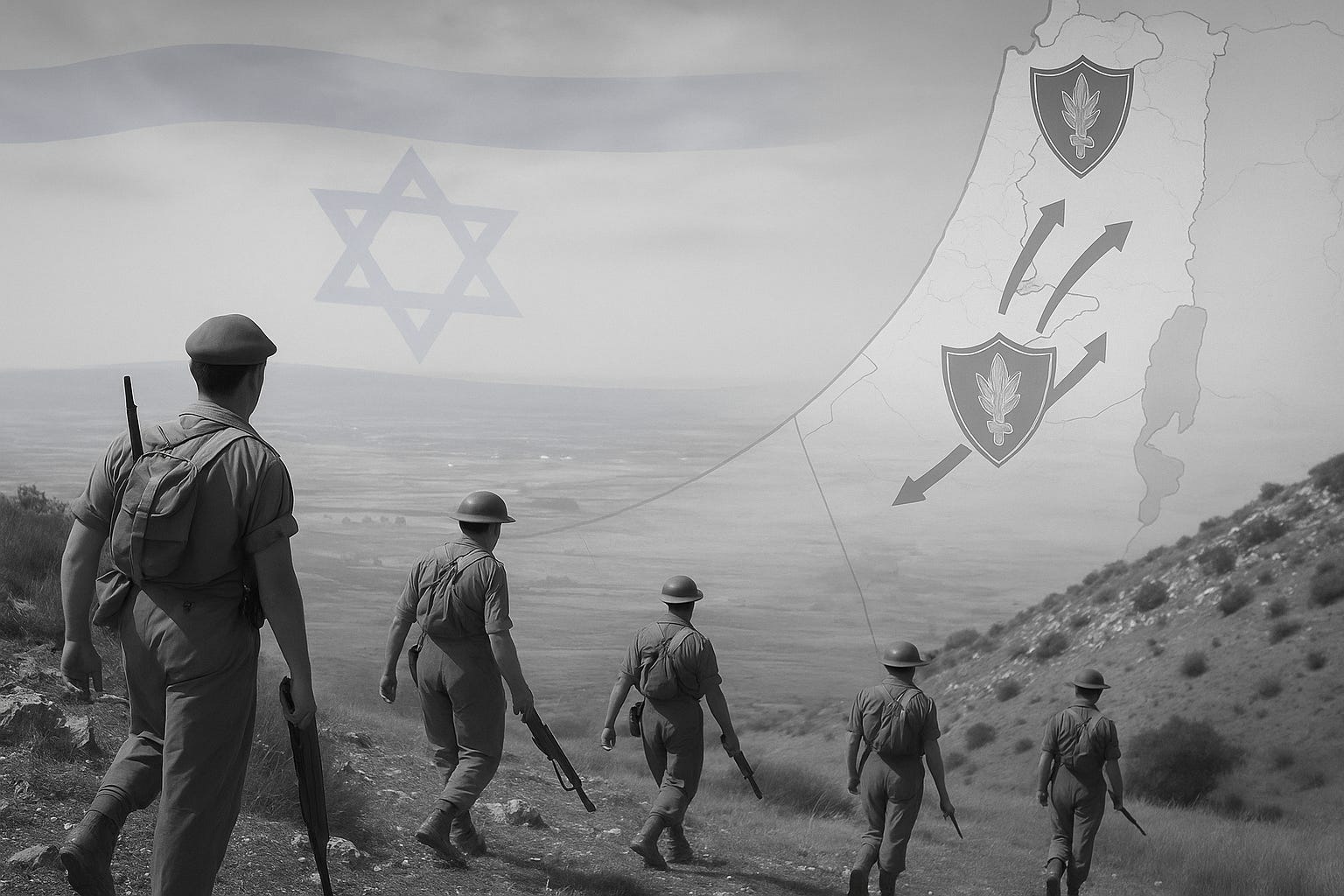
Plan Dalet is one of the most misunderstood and misrepresented documents in Israel’s history.
Critics often call it a secret blueprint for ethnic cleansing. Activists repeat it as proof that the Zionist movement planned to expel Arabs long before the 1948 war began.
In reality, it was nothing of the sort.
The Plans Before Plan Dalet
Plan Dalet was not created in isolation.
The Haganah (The Pre-Israel Military) had drawn up three earlier defence plans between 1945 and 1947. Each one adapted to the worsening security situation as British rule weakened:
Plan A (Aleph, 1945) focused on defending Jewish settlements in case of Arab revolt or British hostility.
Plan B (Bet, 1947) added regional defence zones, preparing for larger Arab attacks.
Plan C (Gimel, late 1947) introduced limited counter-strikes against armed groups threatening Jewish areas.
When open war broke out after the UN Partition vote, these plans were no longer enough.
The Haganah needed to move from defence to control, and that is where Plan Dalet came in.
What It Really Was
Plan Dalet, approved in March 1948, aimed to secure the areas assigned to the Jewish state under the (never implemented) UN Partition plan and ensure supply routes between them.
It authorised taking control of hostile villages and strategic points, but only when they posed a threat. The language was military, not ideological. There was no instruction to expel Arab civilians simply for being Arab.
It was a wartime contingency, written while the British were leaving, Arab militias were attacking, and foreign armies were preparing to invade. Without a clear plan, Jewish communities risked being cut off or destroyed.
How It Was Used
Some local commanders interpreted their orders more broadly, occasionally leading to the destruction of villages or the flight of residents, while others acted with restraint. The Haganah was still a loose network of regional forces, often making quick decisions under pressure and with limited oversight.
Those local excesses were later used to claim that Plan Dalet was a masterplan, but the evidence does not support that.
While a Zionist administration was preparing to assume government once the British left, there was still no formal state government or cabinet, and the Haganah had not yet become a unified national army capable of issuing such a policy.
By the time Israel declared independence in May, thousands of Arabs had already fled, many out of fear, some following evacuation calls from Arab leaders. The chaos of war, not a central directive, drove most of the displacement.
The Political Myth
Over time, Plan Dalet became a political tool. Writers like Ilan Pappé called it proof of a planned expulsion, while others, including Benny Morris, Yoav Gelber and Anita Shapira, saw it as a defensive military plan shaped by circumstance.
Pappé’s interpretation gained traction in activism and propaganda, but it rests on speculation about intent rather than on what the document actually says.
While some sources still present Plan Dalet as a conquest plan, fully designed to expel Arabs, accurate reading of primary documents and cautious historical research reveals greater ambiguity.
Plan Dalet has since become part of a wider narrative that turns Israel’s fight for survival into a story of premeditated aggression. That may suit politics, but it does not match the facts.
The Truth
Plan Dalet was written not to destroy a people, but to protect one.
It came from desperation, not design. It was the moment a defence force prepared for statehood in the middle of civil war.
Some things that happened under its shadow were ugly, but to call it a plan for ethnic cleansing is to ignore its context and its purpose. It was about keeping the Jewish population alive in a collapsing land.
References:
Plan Dalet document, Haganah Archives (March 1948).
Benny Morris, The Birth of the Palestinian Refugee Problem, 1947–1949 (Cambridge, 1987).
Yoav Gelber, Palestine 1948: War, Escape and the Emergence of the Palestinian Refugee Problem (Sussex Academic, 2001).
Anita Shapira, Israel: A History (Brandeis, 2012).