

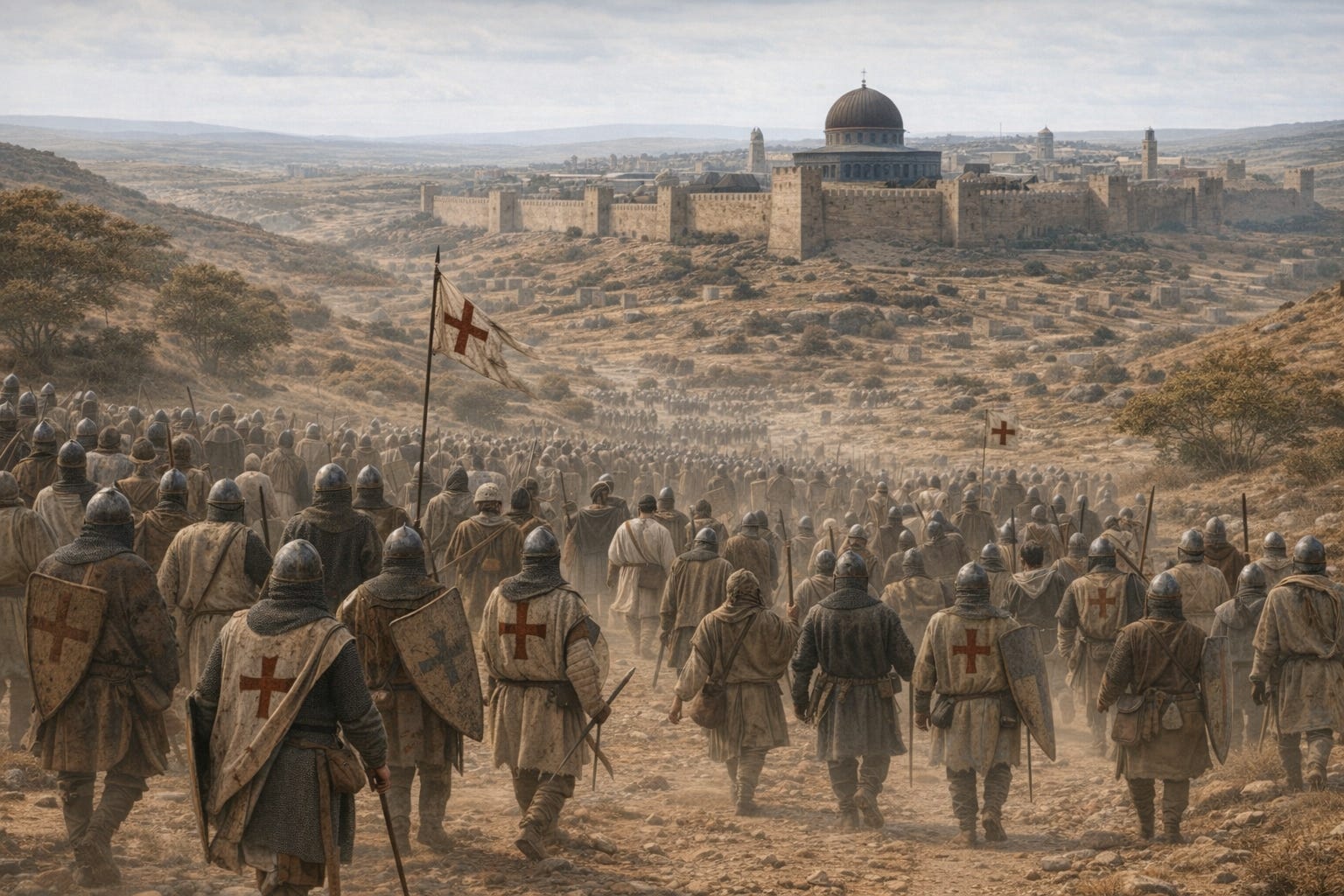
Historians estimate that somewhere between 60,000 and 100,000 people answered the call to the First Crusade, though only a fraction would survive the long journey to Jerusalem.
It began, as so many conflicts in this land did, with a call from afar.
In 1095, Pope Urban II stood before a crowd in Clermont, France, and urged Christendom to march east – to reclaim the Holy Land from Muslim rule. What followed was less a pilgrimage than a campaign of conquest, driven as much by greed and ambition as by piety.
The Crusades were far from the first foreign conquest of this land. Long before them it had been ruled by empires including the Romans and Byzantines, and later the Islamic caliphates that swept through the Levant in the seventh century. What made the Crusades different was that they represented Europe’s first large‑scale return to the region after centuries of absence: a collision of religion, empire, and imagination that left scars still visible today.
Background: The Seljuks and the Road to War
By the eleventh century, power in the Islamic world had shifted. The Abbasid Caliph in Baghdad still held religious authority in theory, but real power had fragmented among regional rulers. One of the most powerful of these new forces was the Seljuk Turks, a nomadic people from Central Asia who had converted to Sunni Islam and built an empire stretching from Persia to Anatolia while ruling in the caliph’s name.
In 1071 the Seljuks defeated the Byzantine army at the Battle of Manzikert, a disaster that opened much of Anatolia to Turkic settlement and pushed Emperor Alexios I Komnenos to seek military assistance from Western Europe. They later seized Jerusalem in 1073 from the Shi’a Fatimid Caliphate of Egypt.
Under Fatimid rule Christian pilgrims had generally been able to reach the city, but under the Seljuks access became uncertain. Reports of harassment and attacks on pilgrims – some real, others exaggerated – spread across Europe, feeding fear and outrage. The Byzantines, reeling from their losses, appealed to the Pope for help against the advancing Turks, a request Pope Urban II would transform into a wider religious cause: the liberation of Jerusalem and the salvation of Christendom.
Origins and Motives
Europe itself was fractured, restless, and hungry – spiritually and materially. The Papacy sought to reassert authority after centuries of decline; the nobility sought land and fortune; and many ordinary people sought redemption and escape from hardship.
Pope Urban II also had a strategic motive: by aiding the Byzantine Empire against the Turks he could strengthen papal influence over secular rulers and perhaps even ease the recent East–West Schism of 1054. In calling for a united Christian campaign, Urban saw an opportunity to rally Europe’s quarrelling princes under one holy banner. It was political calculation cloaked in sanctity.
For decades, Western Christians had travelled to Jerusalem in growing numbers – monks, nobles, and ordinary believers alike.
Reports of robbery and murder along the pilgrim routes, especially after the Seljuk Turks seized Jerusalem, gave the papal message its emotional power. To protect these pilgrims became both a moral cause and a practical mission. The newly founded Knights Templar embodied this duality: warrior monks who escorted travellers and safeguarded their funds through an early system of banking.
When Urban spoke at Clermont, he wove all these strands together – fear, faith, ambition, and outrage – into one unifying purpose. His words turned warfare into worship, and the symbol of this new form of sanctified violence was the cross.
The March to The Holy Land
The movement that became known as the First Crusade actually unfolded in two waves. The first was the so‑called People’s Crusade of 1096, a largely unorganised mass of peasants, zealots, and minor knights who set off before the main armies. Many of the attacks on Jewish communities in the Rhineland occurred during this phase, and most of these groups were eventually destroyed before reaching the Holy Land.
The second wave, sometimes called the Princes’ Crusade, consisted of more organised forces led by European nobles. These armies would ultimately march across Anatolia and the Levant and capture Jerusalem in 1099.
Tens of thousands left their homes believing they were serving God, yet they also sought land, wealth, and redemption – a potent mix of faith and opportunism that would echo through later centuries of European expansion.
The Rhineland Massacres
As they moved east, the Crusaders left devastation behind. Most of the violence occurred during the chaotic People’s Crusade, when loosely organised bands moved ahead of the main armies. Jewish communities along the Rhine – where historians estimate roughly 4,000–10,000 Jews were killed in the massacres of 1096 – became some of the first victims of this movement.
In Worms, Mainz, and Cologne, mobs of armed pilgrims slaughtered entire populations, convinced that killing non‑believers brought divine favour. In several towns local bishops attempted to protect Jewish residents by sheltering them in churches or episcopal residences, though these efforts often failed once the crowds forced their way inside.
For many participants the violence was framed as part of the same holy struggle they believed awaited them in Jerusalem: European Jews were cast as enemies of Christ within Christendom itself. Some crusading groups seized Jewish property to fund their journey east, and in a number of cases Jews were forced to choose between conversion and death.
These perpetrators were not disciplined knights but mobs of peasants, minor knights, and opportunists – Europe’s dispossessed answering a spiritual call with earthly violence.
The Taking of Jerusalem
By the time the First Crusade reached Jerusalem in 1099, the Fatimid Caliphate of Egypt had already retaken the city from the Seljuks in 1098, yet the campaign had transformed into something far greater – and far darker – than the Church had likely foreseen. The city was taken in blood. Contemporary chroniclers described Crusaders wading through bodies in the streets as Muslim and Jewish inhabitants were killed during the capture of the city.
The Latin Kingdom of Jerusalem was born: a Christian enclave carved into the Muslim East, built on conquest, hierarchy, and imported European rule.
For Jews, the Crusades were a double tragedy. In Europe they were hunted as heretics; in the Holy Land they were caught between warring empires. Crusaders saw them as part of the same world that had to be “purified,” while Muslim rulers, though continuing to offer Jews legal protection under the dhimmi system, increasingly imposed restrictions and regarded them with suspicion – more threads in the long fabric of exile and fear.
What began as a campaign to “liberate” Jerusalem became a century-spanning cycle of revenge. Crusade followed counter-crusade; faith answered faith. Over time, the holy cause gave way to commerce and politics – and finally – to ruin.
The crusading kingdoms collapsed, but the idea of the Holy Land as Europe’s to reclaim never truly died. It lingered in the Western imagination, ready to reappear under new flags and modern justifications.
The Word “Crusade”
The very term crusade comes from the Latin crux, meaning “cross.” To go on crusade was to be crucesignatus – “signed with the cross.” The early participants didn’t see themselves as “crusaders” in the modern sense; they were pilgrims with swords, taking up arms as an act of faith. The Church literally branded the campaign with holiness.
The word itself evolved later. In medieval Latin, cruciata referred to something marked by the cross, and in Old French it became croisade. English adopted crusade much later, in the sixteenth century – long after the actual campaigns had ended. By then, the word had taken on a new life: any zealous moral mission could be called a “crusade.”
That linguistic drift matters. The same word that once justified massacre came to signify righteousness. In its journey from blood to virtue, crusade became a symbol of how language sanctifies power – a reminder that words themselves can conquer.
Later Crusades
The capture of Jerusalem in 1099 was the high point of the crusading movement. Later crusades attempted to repeat that success, but none matched the scale or impact of the first. The Second Crusade (1147–1149) was launched after the fall of the Crusader state of Edessa, yet it ended in failure when European armies were defeated in Anatolia and outside Damascus. The Third Crusade (1189–1192), led by figures such as Richard the Lionheart and the Muslim leader Saladin, managed to recover parts of the coast but failed to retake Jerusalem itself.
Subsequent crusades grew increasingly fragmented and political. Some never even reached the Holy Land. The Fourth Crusade (1202–1204) notoriously diverted to Constantinople, where crusaders sacked the Christian city they had supposedly come to defend. Later expeditions achieved little beyond brief coastal footholds or diplomatic arrangements. For the purposes of understanding the history of Israel and Palestine, these campaigns mattered far less than the First Crusade, which created the Crusader states and permanently altered the region’s political and religious landscape.
Legacy
The Crusades led to the creation of a series of Crusader states in the Levant – including the Kingdom of Jerusalem, the Principality of Antioch, the County of Tripoli, and the County of Edessa – which survived for nearly two centuries. Over time these states were gradually reconquered by Muslim powers, most famously under the leadership of Saladin, who retook Jerusalem in 1187. The Crusades reshaped Europe and the Middle East alike.
They deepened the divide between Christianity and Islam, devastated centuries‑old Jewish communities in parts of Europe, and laid early foundations for the idea that the Holy Land was a prize to be claimed by outsiders. Their ruins still mark the landscape – not just the castles scattered across Syria and Palestine, but the moral architecture of Western ambition.
When the Crusader states finally collapsed – most decisively with the fall of Acre in 1291 – the Latin Christian experiment in the Holy Land came to an end. In the centuries that followed, new powers would emerge to dominate the region, most importantly the rising Ottoman Empire in the fourteenth century, which would eventually absorb Palestine into a far larger imperial system.
The wars of faith had ended, but the idea of holy land – and holy ownership – endured.