
The Balfour Declaration: Separating Myth from Reality
Conflicting promises and the paragraph that reshaped the Middle East

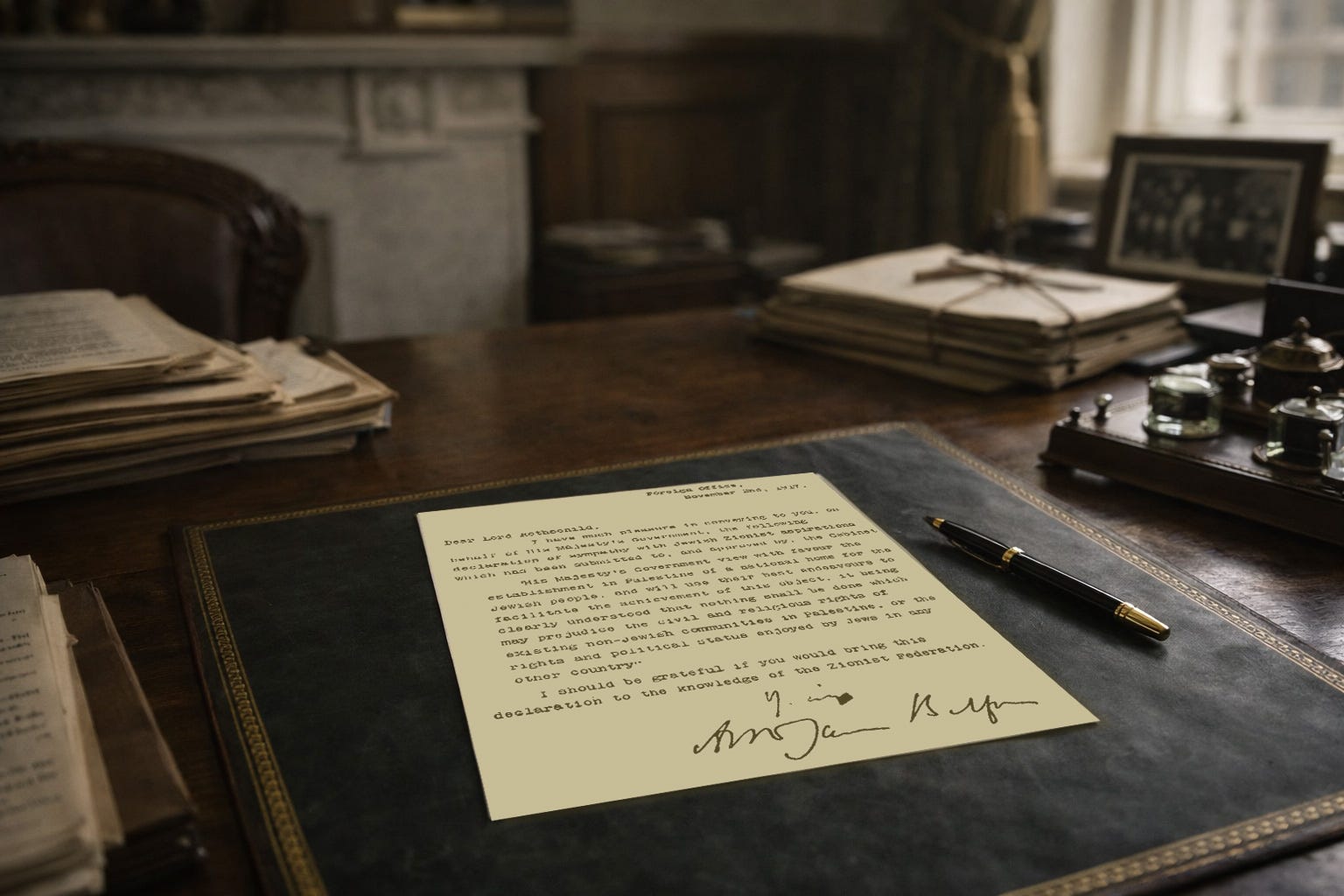
The Balfour Declaration is often described in simple terms: Britain gave away Palestinian land to create Israel.
It is a powerful claim, but it is also misleading.
The Balfour Declaration did not create Israel. It did not promise a state. It did not define borders. And when it was issued, Britain did not even control Palestine.
Instead, it was a single paragraph inside a wartime letter, written in cautious diplomatic language, shaped by military uncertainty, competing promises, and conflicting national aspirations.
Yet this brief document would go on to influence the modern Middle East more than nearly any other diplomatic statement of the twentieth century.
To understand why, we need to separate fact from fiction.
The World in 1917
In 1917, Palestine was part of the Ottoman Empire, ruled from Constantinople (Istanbul) by a Turkish imperial administration.
This is an important point that is often overlooked. Britain did not take Palestine from an Arab state, and there was no independent Palestinian government to take it from.
Instead, Palestine formed a region in a large, multi‑ethnic empire that had ruled much of the Middle East for several centuries – at a time when identities were shaped more by empire, religion, and local affiliation than by the modern cultural or racial boundaries often assumed today.
Arab populations lived throughout the Ottoman Empire, but they did not rule it. The empire itself was not Arab but largely governed by Turkish elites.
During the First World War, however, the Ottoman Empire was weakening. Britain, fighting alongside its allies, launched a campaign north from Egypt. By late 1917, British forces had captured Beersheba and Gaza, and Ottoman forces were retreating towards Jerusalem.
When the Balfour Declaration was issued on 2 November 1917, Britain was in the middle of this campaign. Jerusalem would fall just over a month later and the rest of Palestine would come under British control in 1918.
This challenges a common assumption. Rather than transferring territory, Britain was signalling diplomatic support during an ongoing military campaign, when the future of the region remained uncertain.
What the Balfour Declaration Actually Said
The Balfour Declaration formed part of a letter from British Foreign Secretary Arthur Balfour, a senior member of the British government, to Lord Rothschild, a leading figure in the British Jewish community.
The letter itself referenced “Jewish Zionist aspirations,” but the formal declaration that followed used more cautious and general language.
It stated:
“His Majesty’s Government view with favour the establishment in Palestine of a national home for the Jewish people, and will use their best endeavours to facilitate the achievement of this object, it being clearly understood that nothing shall be done which may prejudice the civil and religious rights of existing non‑Jewish communities in Palestine, or the rights and political status enjoyed by Jews in any other country.”
The language was cautious and did not promise a state. It did not define borders, and it did not guarantee sovereignty.
Instead, Britain stated that it “viewed with favour” the establishment of a “national home” and would use its “best endeavours” to facilitate this objective.
These phrases are deliberately vague. They reflect diplomatic support, not a concrete legal commitment.
Equally important is the second half of the declaration, which is frequently overlooked. It explicitly states that nothing should be done to prejudice the civil and religious rights of existing non‑Jewish communities in Palestine.
From the outset, the declaration attempted to balance two objectives: support for a Jewish national home and protection for existing populations.
That balancing act would prove extremely difficult in practice and would shape much of what followed.
Jewish Return and Aspirations Before 1917
Jewish aspirations for a return to Palestine did not begin with the Balfour Declaration. Jewish communities had existed continuously for centuries in cities such as Jerusalem, Safed, Hebron, and Tiberias, maintaining a small but ongoing presence under Ottoman rule.
In the nineteenth century, migration began to increase. This was driven by religious attachment, rising nationalism, and worsening conditions for Jews in parts of Eastern Europe, including discrimination, legal restrictions, and violence.
Waves of migrants and refugees, often referred to as the First and Second Aliyah, established agricultural communities and small settlements.
In 1897, the First Zionist Congress, convened by Theodor Herzl in Basel, Switzerland, marked a significant turning point. The congress formally articulated the aim of establishing a Jewish national home in Palestine and helped transform scattered aspirations into an organised political movement.
By the early twentieth century, the communities had grown. New towns, institutions, and agricultural settlements were emerging, and the idea of a Jewish national home was gradually taking shape.
At the same time, Zionist leaders began seeking international support. They recognised that the region remained under Ottoman rule, and that long‑term national aspirations would require backing from a major power. Britain became a natural focus, particularly during the First World War, when the future of Ottoman territories was being actively discussed.
Zionist diplomacy, including efforts by figures such as Chaim Weizmann, sought to persuade British leaders that supporting a Jewish national home aligned with British strategic and political interests.
By 1917, this combination of existing Jewish presence, growing migration, and diplomatic lobbying helped create the conditions in which the Balfour Declaration emerged.
The Ottoman Empire and Arab Aspirations
Although Britain did not take Palestine from an Arab state, Arab aspirations for independence were also growing during the war. However, Arab nationalism was still developing and not universally shared, which contributed to differing expectations about independence and later interpretations of wartime promises.
Arab leaders, particularly Sharif Hussein of Mecca, hoped that the collapse of the Ottoman Empire would lead to Arab independence. Britain encouraged these hopes, partly to weaken Ottoman control and encourage Arab support against a common enemy.
While national boundaries in the Middle East were fluid, and the idea of distinct modern states had not yet fully formed, many Arab leaders envisioned a larger Arab kingdom emerging from the collapse of Ottoman rule, reflecting early Pan‑Arab aspirations.
The McMahon–Hussein Correspondence
Between 1915 and 1916, Britain exchanged letters with Sharif Hussein.
These communications were conducted by Sir Henry McMahon, the British High Commissioner in Egypt, acting on behalf of the British government. The letters suggested that Britain would support Arab independence in certain regions following the war.
However, the correspondence included an important exclusion. Britain excluded “portions of Syria lying to the west of the districts of Damascus, Homs, Hama and Aleppo.” This wording would later become highly contentious.
If one draws a line south from Damascus, all of what later became Israel lies west of Damascus. Under this interpretation, Palestine would have been excluded from the proposed Arab state.
However, the wording did not state a clear boundary. It referred to “districts,” which were not precisely defined. Arab leaders largely interpreted the exclusion as referring primarily to coastal Syria and Lebanon, not Palestine.
Britain later argued that Palestine had been excluded. Arab leaders argued that it had not.
This ambiguity lay at the heart of later disagreements. Britain may have deliberately used vague language to preserve flexibility, but it is also possible that the geography was genuinely unclear, and that long‑term consequences were not fully anticipated.
Either way, the seeds of later conflict were planted.
The Sykes‑Picot Agreement
Complicating matters further was the 1916 Sykes‑Picot Agreement, negotiated between Sir Mark Sykes, a British diplomat, and François Georges‑Picot, a French diplomat.
Acting on behalf of their governments, they sought to plan how former territories might be divided if the Allies defeated the Ottoman Empire.
The agreement split much of the Middle East into British and French spheres of influence. Unlike the McMahon correspondence, Sykes‑Picot was explicit, envisioning European control or influence over large parts of the region.
The negotiations were conducted in secret. Britain was encouraging Arab leaders to revolt against Ottoman rule, and public knowledge of European plans to divide the region could have undermined that effort.
Secrecy therefore allowed Britain and France to coordinate their strategic interests while maintaining wartime diplomacy with Arab leaders. When the agreement later became public, it fuelled resentment and a large number of Arabs saw it as contradicting wartime promises of independence.
For many observers, Sykes‑Picot represented a greater limitation on Arab independence than the Balfour Declaration itself.
The Partition of Transjordan
Another frequently overlooked development occurred in 1921–1922, when Britain separated the Mandate area east of the Jordan River from the area west of the Jordan River.
Effectively removing a large portion of the territory from the scope of a Jewish homeland, Britain took this decision partly to compensate the Hashemite leadership after they had lost control of the Hejaz – while also attempting to honour wartime commitments and stabilise the region under British influence.
Jewish settlement was then concentrated to the west of the river, and the region – known as Transjordan – was later to become the Hashemite Kingdom of Jordan.
Many influential Zionist leaders expressed disappointment, viewing it as a significant reduction in the territory originally associated with the Jewish national home.
The Mandate: When the Declaration Became Law
A commonly misunderstood fact is that the Balfour Declaration had no legal force when it was issued. It was a letter; not a treaty, not legislation, and not binding international law.
Its significance grew later, when, in 1922, it was incorporated into the League of Nations Mandate for Palestine.
After the war, the future of former Ottoman territories was debated among the Allied powers. By this time, the idea of a Jewish national home had already gained political traction.
British officials were increasingly influenced by longstanding religious and historical sympathy for Jewish return, and the belief that a Jewish national home could contribute to stability in a strategically important region near the Suez Canal.
There were also humanitarian considerations. Jewish communities in Eastern Europe had experienced decades of persecution, violence and legal discrimination. For some British policymakers, the idea of a Jewish national home was seen as a practical response to ongoing instability and insecurity faced by Jewish populations.
In 1920, at the San Remo Conference, Britain was assigned responsibility for Palestine, and the principles of the Balfour Declaration were formally adopted by the Allied powers.
The Mandate incorporated the language of the Balfour Declaration and tasked Britain with facilitating the establishment of a Jewish national home, while protecting the rights of existing communities.
The declaration had moved from a wartime political statement to an internationally recognised framework endorsed by the League of Nations.
Reactions to this development were mixed. Arab leaders, increasingly opposed the Mandate, arguing that it prioritised Jewish national aspirations while limiting Arab independence. Zionist leaders, however, viewed the Mandate as an important step toward international recognition of Jewish aspirations.
Protests and political opposition began to grow, laying the groundwork for tensions that would intensify in the years that followed.
The Clause: Nothing Shall Be Done
The Balfour Declaration included a clause stating that the rights of existing non‑Jewish communities should not be prejudiced.
“... it being clearly understood that nothing shall be done which may prejudice the civil and religious rights of existing non‑Jewish communities in Palestine, ...”
At least initially, this was largely the case. The declaration itself did not immediately alter governance, ownership, or daily life. Jewish immigration continued gradually, widespread violence had not yet developed, and British policy remained cautious and uncertain.
However, fears began to grow among segments of the Arab population. Early disturbances, including the 1920 Nebi Musa riots and the 1921 Jaffa riots, reflected rising tensions and uncertainty about the future.
Some of these fears were grounded in uncertainty about the future, while others were shaped by rumours, political mobilisation, and competing nationalist aspirations.
As opposition hardened, tensions increased. Protests, resistance, and violence contributed to a worsening atmosphere, which in turn reinforced fears on all sides.
This dynamic risked becoming self‑reinforcing. The more tensions escalated, the more each side feared the intentions of the other. Attempts to push back against perceived future threats often contributed to the very instability that many feared.
Over time, mistrust deepened, and coexistence became more difficult, creating a cycle in which fear, reaction, and escalation fed into one another.
Myth, reality and the world that followed
The Balfour Declaration was a short diplomatic statement issued during wartime uncertainty. It expressed support for a Jewish national home, but left crucial questions unresolved and open to interpretation.
At the same time, the overlapping promises, secret agreements, and shifting wartime diplomacy created a sense of uncertainty and mistrust. From both Arab and Jewish perspectives, British decision‑making increasingly appeared inconsistent and, at times, underhanded.
Arab leaders saw Western involvement as shaping a regional order that reflected imperial interests rather than independence, while Zionist institutions grew frustrated with decisions ranging from the appointment of the Mufti of Jerusalem to later policy shifts culminating in the 1939 White Paper.
Over the following decades, British policy continued to evolve through difficult and sometimes contradictory decisions, each attempting to balance competing pressures while often deepening tensions on the ground.
Understanding this complexity does not resolve the conflict. But it does help to clarify how a short statement, written during a moment of uncertainty, became part of a much larger and more complicated story. It outlined no borders, promised no sovereignty, and was issued before Britain had even taken control of Palestine.
Instead, it expressed support for a Jewish national home within a complex and uncertain environment.
The result was not a single turning point, but a gradual and complex reshaping of the Middle East, influenced by fear, aspiration, diplomacy, and unintended consequences.
Further Reading